SubwooferGenius

How to connect a subwoofer to a receiver

How you connect depends on one thing: whether your receiver or amplifier has a subwoofer output. Almost every home theater (AV) receiver has one. Many stereo amplifiers and older receivers don't, and for those you connect with speaker wire or the amplifier's pre-outs instead.

Steps 1 to 3 cover receivers with a subwoofer output, steps 4 and 5 cover amplifiers without one, and step 6 sets everything up. Which cable to buy is covered in the subwoofer cables guide; this page is about where each one goes.

Connect it in this order

  1. Find the subwoofer output on the receiver

    Look on the back panel for a single RCA jack labelled SUBWOOFER, SUB OUT or SUBWOOFER PRE OUT; the wording varies by brand. On AV receivers it usually sits with the other pre-out jacks, and some receivers have two. If you find one, carry on with step 2. If not, skip to step 4.

  2. Run one RCA cable to the subwoofer's LFE input

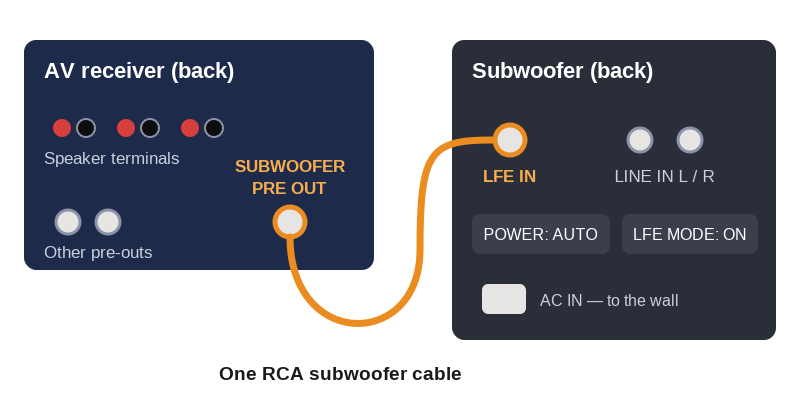
    Connect a single RCA cable from the receiver's subwoofer output to the subwoofer's LFE input. If the subwoofer has no LFE input, use the line input marked L or MONO; some manuals suggest a Y-splitter into both L and R, so follow yours. The receiver decides which sounds go to the subwoofer, so this one cable is all the signal it needs.

    Diagram: one RCA cable runs from the SUBWOOFER PRE OUT jack on the back of an AV receiver to the LFE IN jack on the back of a powered subwoofer.
    AV receiver to subwoofer: one cable from SUBWOOFER PRE OUT to LFE IN. Labels vary by brand.
  3. Plug in the power and set the subwoofer's switches

    Plug the subwoofer into the wall and set its power switch to AUTO, so it wakes up when it receives a signal. If it has an LFE or bypass switch, turn it on. If it doesn't, turn its crossover dial to the highest setting, so the receiver's crossover does the filtering instead of both fighting over it. Set the subwoofer's volume to about halfway for now.

  4. No subwoofer output? Use the subwoofer's speaker-level inputs

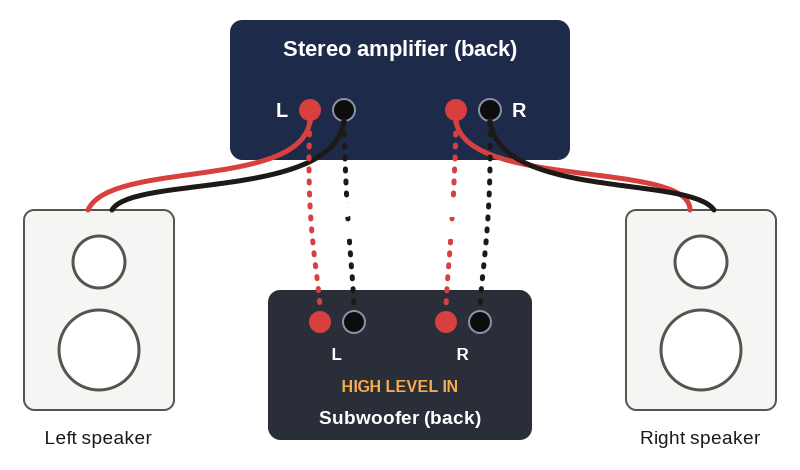
    If the subwoofer has speaker-level inputs (often labelled HIGH LEVEL IN or SPEAKER IN), run a second pair of speaker wires from the amplifier's left and right speaker terminals to those inputs, alongside the wires that already go to your speakers: red to red (+), black to black (−). Check first, because not every subwoofer has them: of the 25 powered home subwoofers in our database, 7 do, and REL is the brand most committed to them. If yours has only RCA inputs, a speaker-level to line-level converter, a small adapter, lets it take its signal from the speaker terminals instead.

    Diagram: a stereo amplifier's left and right speaker terminals feed the two speakers, and a second pair of wires from the same terminals runs to the HIGH LEVEL IN terminals on the back of a subwoofer.
    Speaker-level connection: a second pair of wires from the same amplifier terminals to the subwoofer's HIGH LEVEL IN.
  5. Stereo amp with pre-outs? Use the line inputs, not LFE

    Some stereo amplifiers and preamps have PRE OUT jacks for the left and right channels instead of a subwoofer output. Run two RCA cables from them to the subwoofer's L and R line inputs. Don't use the LFE input here: these outputs carry the full range of sound, so the subwoofer's own crossover has to filter it. Set that crossover to around 80 Hz to start.

  6. Set up the receiver

    In the receiver's speaker setup menu, set the subwoofer to Yes (or On) and your main speakers to Small, then set the crossover to 80 Hz, a common starting point. If the receiver has automatic room correction, such as Audyssey, YPAO or Dirac, run it now with its microphone at your seat; it sets the subwoofer's distance and level for you. Then fine-tune with the crossover, phase and gain guide.

Worth knowing

  • A passive subwoofer, one with no power cable, has no amplifier inside, so it can't be connected straight to a receiver's subwoofer output. That output carries a signal too weak to drive a speaker on its own; a passive subwoofer needs its own amplifier between the two.
  • If your receiver has two subwoofer outputs, it can run two subwoofers. Two subwoofers smooth out the bass across a room, which the single vs dual subwoofers guide explains.

Frequently asked questions

Can I connect a subwoofer to a receiver without a subwoofer output?

Yes. If the subwoofer has speaker-level inputs, connect it with speaker wire from the receiver's speaker terminals (step 4). If the receiver has pre-outs for the left and right channels, use those with the subwoofer's line inputs (step 5). If neither applies, a speaker-level to line-level converter bridges the gap.

Should I use the LFE input or the line input?

Use LFE when the signal comes from an AV receiver's subwoofer output, because the receiver has already filtered it. Use the line inputs when the signal is full range, such as from a stereo amplifier's pre-outs, so the subwoofer's own crossover can filter it.

Why is there no sound from my subwoofer after connecting it?

Check that the receiver's speaker setup has the subwoofer set to Yes, that the subwoofer's power switch is on AUTO or ON, and that its volume isn't turned down. Also make sure the cable goes into the subwoofer's input, not an output jack labelled LINE OUT.

Can I connect a passive subwoofer to a receiver?

Not directly to the subwoofer output, which can't drive a speaker on its own. A passive subwoofer needs a separate amplifier: the receiver's subwoofer output feeds the amplifier, and the amplifier powers the subwoofer.